
Skip to content

Recent Posts

  • Ancient Egypt Slots: From Scarabs to Free Spins
  • How Free Slots Support Game Testing Before Real-Money Release
  • Wild Mechanics: How Sticky Wilds Change Bonus-Round Mathematics
  • Most Popular Slot Themes and Why They Keep Returning
  • Pragmatic Play Slots Guide: From Paylines to Cluster Pays

Most Used Categories

  • Slot Themes (4)
  • Slot Features (4)
  • Mobile Slots (4)
  • Megaways Slots (3)
  • Jackpot Slots (3)
  • Free Slots (3)
  • Slot Guides (3)
  • High-RTP Slots (2)
  • Slot Providers (2)
  • Slot Reviews (2)
Skip to content
Isa Automation Week

Isa Automation Week

Subscribe
  • Free Slots
  • Slot Themes
  • Jackpot Slots
  • Slot Features
  • Mobile Slots

Home › Slot Features

Category: Slot Features

Wild Mechanics: How Sticky Wilds Change Bonus-Round Mathematics

Wild Mechanics: How Sticky Wilds Change Bonus-Round Mathematics

Lucía Fernández08/28/202608/14/2026

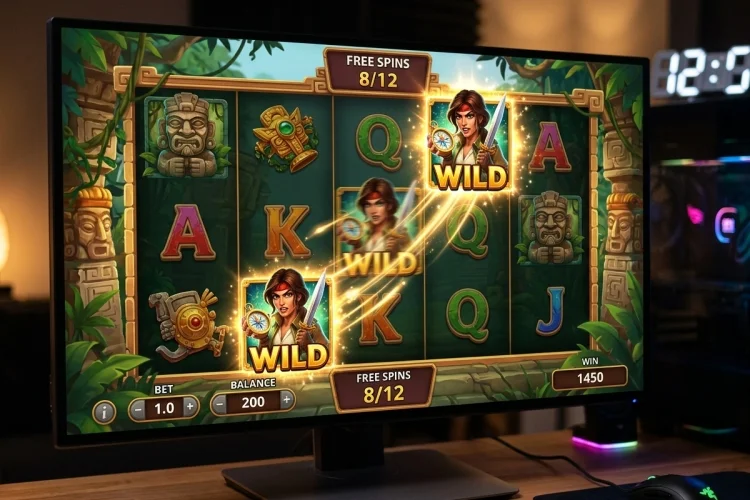
Many free-spin bonuses look like a simple collection of discounted or free game rounds. Sticky wilds turn them into something closer to an evolving mathematical system.

Once a sticky symbol appears, it may remain available for several future spins. A second wild can join it, followed by a third, creating a grid whose probability structure changes as the bonus progresses. This makes Wild Mechanics based on persistence fundamentally different from ordinary wild substitution.

The important concept is not merely that a wild stays visible. Persistence creates future value. Every remaining spin becomes another opportunity for that position to contribute to a combination, multiplier, or feature event.

Add retriggers and increasing multipliers, and the final feature value can depend heavily on when sticky symbols appear, how long they survive, and how many accumulate simultaneously.

Ordinary Spins Reset Their Relevant Symbol State

In a basic slot structure, each game round largely starts with a fresh symbol layout.

A wild appearing on spin five does not normally remain available on spin six.

Sticky features deliberately break this visual reset.

Pragmatic Play’s Lobster House, for example, offers between nine and 27 free spins, with multiplier wilds staying in position until the feature ends.

That turns the bonus grid into a persistent state machine.

Suppose the feature begins with a five-reel layout and no locked wilds.

After several spins, reel two contains one sticky wild and reel four contains another.

Every subsequent outcome is now evaluated against those known positions.

The unknown part of the spin continues changing.

The persistent portion does not.

This combination of fixed and random elements is what makes the probability model interesting.

A Sticky Wild Has Future Expected Value

A normal wild receives most of its value from the spin on which it appears.

A sticky wild can provide value repeatedly.

Suppose an illustrative sticky wild contributes an average additional expected payout of 0.15 units on every future spin where it remains active.

If it survives for six more rounds, a crude approximation of its future contribution is:

0.15 × 6 = 0.90 units

If the same wild appears with only two spins remaining:

0.15 × 2 = 0.30 units

These are not real game figures; they simply demonstrate why timing matters mathematically.

The value of persistence depends on the number of remaining opportunities.

That means two identical wild symbols can have different expected future values solely because one appears earlier in the bonus.

Developers can account for this through simulation across every possible feature state.

Accumulation Creates Nonlinear Value

Sticky symbols become particularly interesting when several can exist at once.

Suppose one locked wild increases the probability of completing a selected type of combination from an illustrative 10% to 14%.

Adding a second wild might not merely increase it to 18%.

If the wilds occupy different important reels, their interaction could support combinations that neither position could complete alone.

The resulting probability might jump further.

This is a form of nonlinear interaction.

Pragmatic Play’s The Dog House: Royal Hunt uses sticky 2x and 3x multiplier wilds during Free Spins, allowing both position persistence and multiplier effects to remain active through the feature.

When several persistent wilds become part of the same win, the mathematical importance of their combined state can be much larger than that of one isolated wild.

This is why sticky-heavy bonus rounds can develop dramatic late-stage configurations.

Permanent and Temporary Sticky Wilds Behave Differently

Not all sticky symbols remain active for the entire feature.

Pragmatic Play’s Forging Wilds uses another approach: bonus wilds remain sticky for a random number of spins rather than automatically surviving until the bonus ends.

That creates another probability dimension: duration.

A wild can now have several possible state transitions.

It may:

remain for one additional spin,

remain for several,

or disappear while the feature is still running.

From a mathematical perspective, the engine needs to model the probability of each lifespan together with the value generated during that period.

This produces something resembling a simple state-transition model.

For example:

Active Wild → Remains Active → Remains Active → Expires

Another instance might follow:

Active Wild → Expires

The expected value of the feature depends partly on the probability assigned to each path.

That is considerably more complicated than a static wild symbol.

Retriggers Extend Existing Wild Value

Free-spin retriggers are powerful partners for persistence.

Consider a wild landing on spin three of an eight-spin bonus.

Initially it has five future spins available.

Now suppose a scatter combination awards ten additional spins.

That wild suddenly has many more opportunities to contribute, assuming the rules keep it active throughout the extended feature.

Pragmatic Play’s Wild West Gold combines sticky multiplier wilds with retriggers that can add further free spins.

This creates two sources of bonus value:

new spins, which have value themselves, and

extended persistence, which makes existing wild positions useful for longer.

A retrigger can therefore be worth more when the grid is already heavily developed than when no sticky symbols have accumulated.

This is an important example of conditional expected value.

The same ten extra spins do not necessarily have identical theoretical value in every possible feature state.

Sticky Multipliers Can Make Late States Highly Valuable

Persistence becomes even more dramatic when wild multipliers can grow.

Pragmatic Play’s Candy Stars features sticky wild symbols whose multiplier increases when they participate in wins; during Free Spins, that multiplier escalation can become even stronger, reaching a stated maximum of 128x.

Now imagine a sticky wild landing early.

It has two potential forms of future value.

First, it can substitute repeatedly.

Second, successful participation may increase its multiplier for subsequent outcomes.

This creates a compounding state.

An early wild that repeatedly contributes to wins can become much more valuable later than when it initially appeared.

The feature therefore has an evolutionary quality:

position acquired → win participation → multiplier increases → future expected value changes

The game is not merely repeating the same probability calculation.

Its active parameters are changing as the bonus develops.

Sticky Mechanics Can Produce Long-Tail Results

Persistent features often create a wide range of final bonus states.

Some rounds may finish with one weak sticky position.

Others might develop several wilds, high multipliers, and extra spins.

The rarest combinations of those favourable states can create disproportionately large outcomes.

That structure can contribute to volatility.

The UK Gambling Commission explains that volatility is commonly represented using standard deviation, with highly volatile games potentially containing “very large but rare” prize outcomes and low-volatility products producing more predictable distributions.

This does not mean sticky wilds are inherently high-volatility.

Their effect depends on probability weighting.

Frequent low-value sticky symbols could make wins more regular.

Rare sticky symbols carrying large multipliers could push more theoretical return into unusual feature states.

The mechanic is a tool.

The pay model determines how aggressively that tool affects variance.

RTP Still Comes From the Entire Probability Model

It is important not to confuse a powerful-looking feature with higher RTP.

RTP represents a long-term theoretical average built from the probabilities and payout values of all possible outcomes.

The UK Gambling Commission notes that actual RTP can differ noticeably from theoretical RTP over shorter samples because game volatility affects the range of expected results.

A provider can therefore design two games with similar theoretical RTP values but very different bonus structures.

Game A might distribute value through frequent ordinary wins.

Game B might place more of its expected return inside rare, highly developed sticky-wild features.

Their percentages can be similar even though their session patterns feel completely different.

Sticky wilds affect where and when expected value appears.

They do not create value outside the game’s designed mathematical return.

That distinction is critcal when comparing slot mechanics.

The Feature Can Be Modelled as a Sequence of States

One useful conceptual model is to treat every bonus spin as a state.

For example:

State 0: no sticky wilds
State 1: one sticky wild
State 2: two sticky wilds
State 3: two sticky wilds plus multiplier
State 4: three wilds plus retriggered spins

Each spin has probabilities of moving the bonus from one state to another.

Play’n GO’s Honey Rush demonstrates a variation of this idea, where sticky Honeypot wilds can move across the grid and additional Honeypots become available as feature levels progress.

Other games may lock wilds permanently, remove them after specific events, or even allow negative mechanics to remove them. Pragmatic Play’s The Big Dog House, for instance, keeps wilds sticky during its bonus while certain ghost wilds can remove them unless a relevant modifier changes the feature.

These designs show how broad persistence modelling can become.

Sticky does not always mean permanently fixed.

The exact state rules define the mathematics.

Sticky Wild Mechanics transform bonus rounds from collections of isolated spins into evolving probability systems. Persistent positions can accumulate, multipliers can grow, and retriggers can extend the value of already-established wilds.

To analyse these features accurately, track each possible bonus state and how it changes the expected value of the spins that remain. The persistence rules tell the real mathematical story.

Mathematics of Modern Slot Games: Why Feature Stacking Matters

Mathematics of Modern Slot Games: Why Feature Stacking Matters

Lucía Fernández07/16/202608/14/2026

A modern slot can change rules several times during a single wager. The reels land, a cluster pays, symbols disappear, new ones cascade into place, a multiplier increases, a wild expands, and suddenly a bonus feature triggers. What began as one random outcome has turned into a chain of related events.

This is why the Mathematics of Modern Slot Games is increasingly built around feature interaction rather than isolated winning combinations. The RNG still provides random inputs that must follow the game’s approved probability model, but those inputs can lead into different states where new rules apply.

UK Gambling Commission standards require RNG-driven results to remain acceptably random and prohibit compensated or adaptive behaviour.

The challenge for game mathematicians is working out what every possible feature combination contributes to expected return.

Think of a Modern Slot as a State Machine

One helpful way to understand feature-heavy slots is to imagine a state machine.

The game begins in a normal base state.

A particular result might move it into a cascade state. Another outcome could start free spins. Inside the bonus, a wild collection mechanic might unlock another state with enhanced multipliers.

Each state has rules controlling what can happen next.

A simplified flow could look like:

Base Game → Win → Cascade → Multiplier Increase → Bonus Trigger → Free Spins

Not every wager travels through all these stages.

Most may stop after the base outcome. Some enter one additional state, while a tiny proportion travel through several.

The mathematical model needs a probability for each transition and an expected payout for every reachable state.

This state-based approach helps explain why the expected value of a modern slot cannot always be understood from its basic reel strips alone.

RTP Has to Be Allocated Across Multiple Features

Return to player represents theoretical payout over a very large number of plays.

In a simple game, much of that return might come directly from standard line or ways wins.

In a feature-heavy game, RTP can effectively be distributed across several components.

For illustration, imagine a hypothetical 96% theoretical return consisting of:

72% base-game combinations + 8% wild mechanics + 6% cascades + 10% bonus features

These numbers are merely an example, not a description of a particular commercial slot.

The important point is that every feature consumes part of the game’s expected-value budget.

If a new multiplier mechanic materially increases expected payouts, developers cannot simply add it without considering the overall model. Symbol frequencies, base payouts, feature probabilities, or other parameters may need adjustment.

The UK Gambling Commission requires games to operate according to their designed and advertised mathematical behaviour, with game and RNG testing used to verify compliance.

Feature Value Depends on the State Where It Appears

A 3× multiplier does not always have the same expected value.

Suppose the multiplier appears in the base game, where average winning combinations are relatively small.

Now imagine the same 3× multiplier appears during free spins after several wild symbols have already been collected.

Its nominal value is still 3×, but the surrounding state may make it considerably more valuable because it applies to outcomes with stronger winning potential.

This is a central idea in the Mathematics of Modern Slot Games:

Feature value is conditional.

A modifier’s mathematical importance depends on which other mechanics are active when it appears.

The same principle applies to wilds.

One extra wild on a quiet base-game spin may produce little value. A persistent wild early in a long free-spin feature can potentially influence many subsequent outcomes.

So the expected value calculation needs to understand context, not just feature frequency.

Cascades Change the Number of Evaluations Per Wager

Traditional slot thinking often treats one wager as one grid and one evaluation.

Cascades break that relationship.

A paid spin can generate an initial outcome followed by several replacement outcomes without requiring another wager.

Evolution’s Atlantis is a practical example of a slot using cascading mechanics alongside additional wild and multiplier features.

Suppose the probability of continuing from one successful cascade to another falls at every step.

The game mathematician still needs to evaluate:

the chance of reaching each cascade depth, the average payout at each level, and any features that strengthen during the sequence.

If a multiplier grows after every cascade, deeper stages are rarer but potentially more valuable.

The resulting payout distribution develops a long tail.

This is one reason cascade games can generate dramatically different outcomes from wagers that initially look very similar.

Persistent Features Create Mathematical Memory

RNG outcomes themselves should remain random rather than adapting based on whether the player has recently won or lost.

However, a game can still have legitimate state-based mechanics where information carries forward because the rules explicitly say it does.

A collected wild may remain active.

A multiplier meter might increase through a bonus.

A feature could collect symbols until an upgrade threshold is reached.

This creates what could be called mathematical memory within the feature state.

The next outcome is still randomly generated according to the defined rules, but its payout consequences depend on the state created by earlier events.

For example, landing a particular symbol in Free Spin 2 might increase the multiplier for Free Spins 3 through 10.

The value of that symbol therefore includes its immediate effect plus its expected impact on all remaining spins.

Ignoring that future contribution would underestimate its real EV.

Retriggers Make Bonus Length a Random Variable

Free spins are another feature that looks simple but quickly becomes complex.

Suppose a bonus awards eight spins.

Without retriggers, modelling the number of spins is easy: there are eight.

Now allow three scatter symbols to award another five spins.

The total feature length becomes random.

Those five extra spins might themselves generate another retrigger. As a result, the expected number of bonus rounds must incorporate a potentially repeating process.

This becomes even more important if another mechanic grows over time.

Imagine the multiplier increases every three winning free spins.

Longer bonus sessions do not merely provide additional opportunities to win—they provide more opportunities to reach stronger multiplier states.

The retrigger and multiplier systems therefore reinforce one another.

This interaction can create significantly more expected value than evaluating each mechanic in isloation.

Feature Stacking Can Amplify Payout Variance

Consider three features:

a wild, a cascade system, and an increasing multiplier.

Each could be relatively moderate when used alone.

Now activate all three together.

The wild increases the probability of forming a combination. That combination triggers a cascade. The cascade increases the multiplier, while the wild—or another wild—helps create the next combination.

The mechanisms begin reinforcing one another.

This is feature stacking.

Its most important mathematical effect is often not a massive change in average RTP, because the overall theoretical return remains deliberately balanced. Instead, stacking can strongly affect variance.

Many ordinary rounds may return modest amounts, while rare occasions where several mechanics align can generate much larger payouts.

The expected value remains determined across the full outcome distribution, but the return becomes more concentrated in unusual feature states.

That is why RTP alone cannot describe the complete feel of a slot.

Maximum Wins Often Sit at the End of Long Probability Chains

Large advertised maximum wins rarely come from a single ordinary symbol match.

They can require several favourable conditions to happen together.

A player might need to trigger free spins, land persistent wilds, create repeated cascades, raise a multiplier, and then form an unusually large combination while those features overlap.

Mathematically, the route can be viewed as a chain of conditional events:

P(Max-State Path) = P(A) × P(B|A) × P(C|A,B) × …

The exact calculation is normally more complicated because there may be multiple possible paths to similar outcomes.

Still, the idea is useful.

Each additional required condition tends to make the final state less frequent.

UK testing procedures recognise the difficulty of observing rare outcomes through ordinary play and permit emulation testing for scenarios including special features and maximum prizes.

A huge payout may therefore have an important place in the theoretical model despite being an extremely rare occurance.

Simulation Becomes Essential as Features Multiply

A small probability model can sometimes be solved analytically.

Feature-heavy games can contain so many states that large-scale simulation becomes extremely useful.

Millions or billions of virtual rounds can be modelled to estimate feature frequency, RTP contribution, payout distributions, cascade lengths, and rare combinations.

Testing does not replace mathematical calculation; it helps verify it.

GLI standards provide a framework used in many jurisdictions for testing interactive gaming systems, including RNG and game-related technical requirements. The UK Gambling Commission likewise requires test results for relevant remote games and RNG-driven products.

Simulation can also expose unexpected interactions.

Perhaps two features activate together more frequently than anticipated. Maybe a rare multiplier state produces more expected return than originally estimated.

These findings matter because one small miscalcuation can affect the economics of millions of future spins.

Players See Features; Mathematicians See Dependencies

From the front end, a modern slot may advertise “Wild Reels,” “Free Spins,” “Cascades,” and “Up to 20× Multipliers.”

Mathematically, these are not four independent boxes.

They are dependencies.

A wild might increase cascade frequency. Cascades may increase multipliers. The multiplier may remain active during the bonus. Bonus retriggers may give all three mechanics additional time to interact.

That interaction network ultimately defines much of the game’s personality.

It influences how often something happens, how large results can become, and how theoretical return is distributed between ordinary and exceptional outcomes.

Understanding those dependencies gives a far clearer picture than examining any single feature in isolation.

The Mathematics of Modern Slot Games is increasingly about dependencies between features. Wilds can extend cascades, cascades can grow multipliers, and retriggers can keep valuable states active for longer. These interactions reshape expected value and volatility without changing the need for controlled RTP and random outcomes.

When analysing a feature-heavy slot, study how its mechanics connect rather than counting features individually.

How Many Scatters Are Needed to Trigger Free Spins in Slots?

How Many Scatters Are Needed to Trigger Free Spins in Slots?

Lucía Fernández06/22/202608/05/2026

Landing scatter symbols can transform an ordinary slot round into a feature filled with free spins, special wilds, multipliers, and changing reel layouts.

However, the exact trigger is not always obvious from the main game screen. Players commonly ask, how many scatters are needed to trigger free spins?

Three is frequently used as the minimum, but some games require a different combination. The number can also affect how many rounds are awarded or which bonus options become available.

That is why counting the symbols is only part of the process. You also need to understand their placement, value, and behaviour during the feature.

What Does a Scatter Symbol Do?

A scatter is a special slot symbol that usually follows different rules from ordinary icons. Standard symbols may need to line up across active paylines, while scatters often count from multiple positions on the grid.

Their main purpose can be to trigger free spins, award a direct payout, activate a bonus screen, or perform several of these functions together.

The paytable should show the relevant icon and explain exactly what it does. Game rules should also describe the conditions needed to qualify for a bonus feature.

The Three-Scatter Format

A familiar setup requires at least three scatters during one paid round. When the third qualifying icon lands, the free spins feature begins after the result has been evaluated.

Three symbols may award a standard number of spins, such as eight, ten, or twelve. These figures vary entirely by game.

The player normally cannot save the feature for later or change the triggering stake once it begins. Any bonus payouts are generally calculated using the wager that activated the round.

Four or Five Scatters May Improve the Bonus

Additional symbols can produce an enhanced starting award. Instead of simply increasing the number of spins, the slot may raise the multiplier or offer a choice between different bonus modes.

For example, four scatters could provide twelve rounds instead of eight. Five might offer twenty spins or begin the feature with an upgraded wild symbol.

A larger bonus award still does not guarantee a larger payout. Twenty rounds can return less than five particularly successful spins because every outcome depends on the game’s probabilities.

Some Games Use Different Trigger Systems

Not every slot follows the three-scatter model. A feature may begin after two oversized symbols land on adjacent reels or after bonus icons appear in specified positions.

Other games use collection mechanics. Players might gather objects over multiple paid rounds until a meter is filled, although the collected progress may sometimes reset according to the game rules.

Mystery triggers can also activate the feature without the usual scatter combination. These alternatives should be clearly explained in the information screen.

Retriggers During Free Spins

Once the feature begins, another set of scatters may add extra rounds. A slot could require three symbols again, or it might allow two to create a retrigger.

The number of added spins can be fixed or linked to the scatter count. For instance, two bonus scatters might add three rounds, while three add five.

Independent game testing can include checking whether free spins, bonus features, special events, and associated payouts activate and operate as intended.

Scatters and the Game’s RTP

Free-spin prizes normally contribute to the slot’s overall theoretical Return to Player percentage. Laboratories may separately examine the mathematical contribution from the base game and feature rounds.

This means some of the game’s expected long-term return may depend on reaching its bonus features. A short session without a trigger can finish far below the stated RTP.

The percentage is measured across a huge number of rounds. It does not promise that a particular bonus will return a specific amount.

Why More Scatters Are Not “Due”

After several rounds showing one or two scatters, it can feel as though a complete trigger must be approaching. Random slots do not work that way.

RNG-driven games rely on the statistical chance of each outcome. Previous wins and losses do not change the odds of winning the current game.

Increasing the stake after repeated near misses does not force the missing symbol to appear. It simply increases the amount at risk.

Three scatters are a common free-spin trigger, but the exact requirement depends on the slot. Four or five symbols may improve the starting award, while some games use two symbols, fixed reel positions, collection meters, or mystery events instead.

Check how scatters behave in both the base game and the bonus round. Pay attention to retriggers, multipliers, and whether additional symbols change the prize.

Most importantly, do not interpret near misses as a signal to keep playing. Read the official rules first, choose an affordable stake, and treat every bonus as an unpredictable entertainment feature.

How Do Free Spins Work in Online Slots? Bonuses and Payouts

How Do Free Spins Work in Online Slots? Bonuses and Payouts

Lucía Fernández06/18/202608/05/2026

A free-spin round can be the most dramatic part of an online slot. The music changes, extra features appear, and the game may award anything from a few ordinary spins to a large chain of retriggers and multipliers.

Yet the animation does not explain how the prize is calculated. Players still need to understand the triggering bet, symbol values, bonus rules, and Return to Player percentage.

This guide explains how free spins work in online slots from the moment the feature is activated until the winnings are added to the balance. It also clarifies why a large number of spins does not necessarily produce a large payout.

The Trigger Is Part of the Base Game

Most feature rounds begin when a qualifying result appears during normal paid play. Three scatters are a common requirement, although the number and placement vary between games.

Some titles offer a random trigger, while others ask players to collect objects across several rounds. Another format allows the player to choose between fewer spins with a stronger multiplier or more spins with weaker features.

The paytable should explain every trigger and prize option clearly before money is wagered.

Free Spins Usually Keep the Triggering Stake

When the bonus starts, it normally preserves the stake used on the activating round. This prevents the player from changing the bet after the feature has already been won.

Imagine a slot awarding ten spins after a $1 triggering bet. If one bonus combination pays eight times that stake, it returns $8.

However, games do not all use identical calculations. Always confirm whether the displayed multiplier applies to the total bet, a line bet, or another value.

Multipliers Can Increase During the Feature

Some free-spin rounds apply a fixed multiplier to every payout. A game might double all feature wins or begin at 1× and increase after each cascade.

For example, a $3 symbol payout with a 4× multiplier becomes:

$3 × 4 = $12

Multipliers can also apply only to certain symbols or reels. The biggest figure shown on the screen may therefore be a maximum possibility rather than the multiplier active on every spin.

Wild Symbols May Behave Differently

Wilds generally substitute for selected regular symbols, but bonus rounds can give them extra abilities. A wild may expand across an entire reel, remain sticky for several rounds, or carry its own multiplier.

These enhancements can increase the number or value of winning combinations. They do not guarantee that the feature will produce a profit.

Independent game testing checks whether free spins, bonuses, special events, and their associated payouts operate according to the programmed rules.

Retriggers Add More Spins

A retrigger occurs when the qualifying bonus symbols land again during free spins. The game may add a fixed number of rounds or reset the remaining total.

Suppose you begin with ten spins and retrigger five more during the fourth round. After completing that fourth spin, eleven would remain.

Some slots allow unlimited retriggers, while others impose a maximum number of rounds. The rules should state any cap clearly.

More Spins Do Not Always Mean More Money

Twenty free spins may sound better than eight, but the number alone reveals very little. The shorter option could have stronger wilds or a larger multiplier.

A feature may also award several small payouts that remain below the amount spent reaching it. A “win” should always be compared with the total stake and the session’s starting balance.

Sound effects and animated coin displays do not change the mathematical value of the result.

How RNG and RTP Affect the Bonus

A Random Number Generator supplies the unpredictable outcomes used by digital slots. Testing laboratories examine the distribution of results and confirm that game scenarios and payouts follow the approved mathematical model.

The bonus round also contributes to the game’s theoretical RTP. A slot with many features may distribute part of its expected return through uncommon bonus events.

That percentage operates across extensive play and cannot predict what one feature will pay.

Review the Final Bonus Total

At the end of the feature, the game normally displays the combined payout from all free spins. Check whether that amount has already been added to the balance.

Compare the result with the cost of the triggering round and the total amount spent throughout the session. This provides a clearer picture than focusing on the bonus total alone.

Never increase the stake because a previous feature paid poorly. The next bonus remains uncertain.

Free-spin payouts depend on the triggering stake, symbol combinations, wild behaviour, multipliers, and retrigger rules. Although additional spins create more opportunities for winning combinations, they do not guarantee a larger final prize.

Read the full paytable to learn how the feature begins and how every multiplier is applied. Keep the original stake affordable and monitor the overall balance rather than celebratory animations.

A bonus can make a slot more entertaining, but it does not remove the house advantage or make future results predictable. Stop once your planned time or spending limit is reached.

Highlights

  • Wild Mechanics: How Sticky Wilds Change Bonus-Round MathematicsWild Mechanics: How Sticky Wilds Change Bonus-Round Mathematics
  • Slot Paytables: A Practical Guide to Reading Game MathematicsSlot Paytables: A Practical Guide to Reading Game Mathematics
  • Mathematics of Modern Slot Games: Why Feature Stacking MattersMathematics of Modern Slot Games: Why Feature Stacking Matters
  • How Many Scatters Are Needed to Trigger Free Spins in Slots?How Many Scatters Are Needed to Trigger Free Spins in Slots?
Stay connected to the fast moving world of technology with insightful articles on devices, software, artificial intelligence, cybersecurity, mobile innovation, and emerging digital trends. We turn complex developments into accessible information, helping readers understand how new technologies work, why they matter, and how they may influence everyday life and business.
GetMobilePrices
Routerlinksyssmartwifi
Fikretorman
TheNorthpoleBar
SingleSmokers
Stromectol1h
Eclector
KetoPremiere
Atozmp3
Bside-rock
Ukinvestmentadvice
Buzfeed.org
MakerFieldSpring
WhiteSwillWinParty
VisitLizardCornwall
Big-HeadBasketball
VideoReview
Woodstock-Exhibition
Ispaziorepository
Accesschc
Hydrophil
SilentKnightsSoaring
RestorerMinistries
Bodybuilding-Blog
DavidsavillPhotography
BetterSingingVoice
1kdailyprofit-official
JainSonUmbrella
Vr7uallms
Dz-Recrute
CuisineMetisse
Alphabetnyc
ProjectThinice
Lympleylodge
AmbProductions
Johnpowellavs
DakarRally
Dumbletoncc
BaconFromAcorns
LogMe
Ffmovies
Daily-News
AirTechNow
Avideo
OpenLoad
OwnerFinancing
Variable-Annuity
GoodBrand
InvestFutureNow
OceanBreeze
JustSummer
OneTech
Naturelv
DepositRetiree
CuteEye
NextVision
LordMovies
Excited
Exporelab
Supav

Recent Posts

  • Ancient Egypt Slots: From Scarabs to Free SpinsAncient Egypt Slots: From Scarabs to Free Spins
  • How Free Slots Support Game Testing Before Real-Money ReleaseHow Free Slots Support Game Testing Before Real-Money Release
  • Wild Mechanics: How Sticky Wilds Change Bonus-Round MathematicsWild Mechanics: How Sticky Wilds Change Bonus-Round Mathematics
  • Most Popular Slot Themes and Why They Keep ReturningMost Popular Slot Themes and Why They Keep Returning
  • About Us
  • Contact
  • Disclaimer
  • Privacy Policy
  • Terms & Conditions
  • Index
© 2026 IsaAutomationWeek | Theme: BlockWP by Candid Themes.