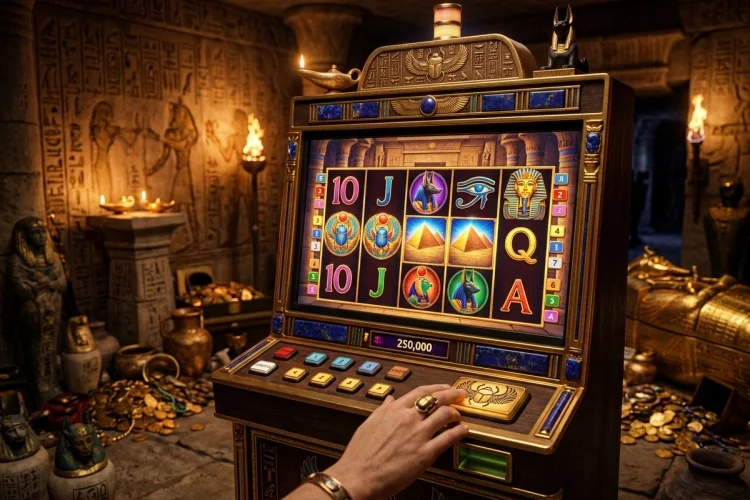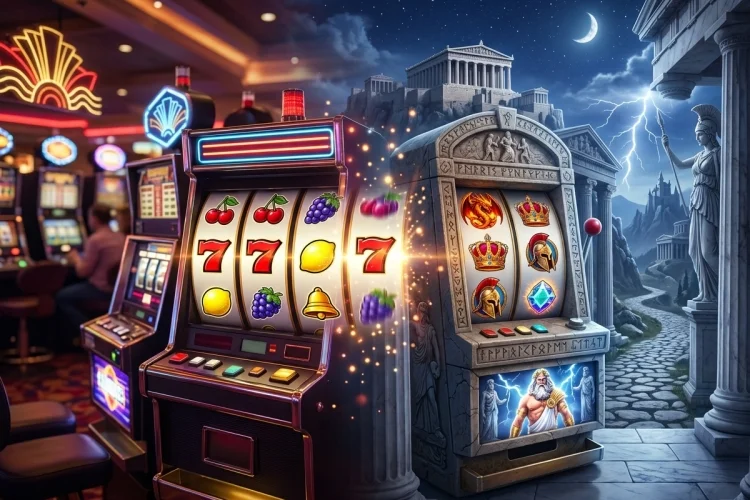
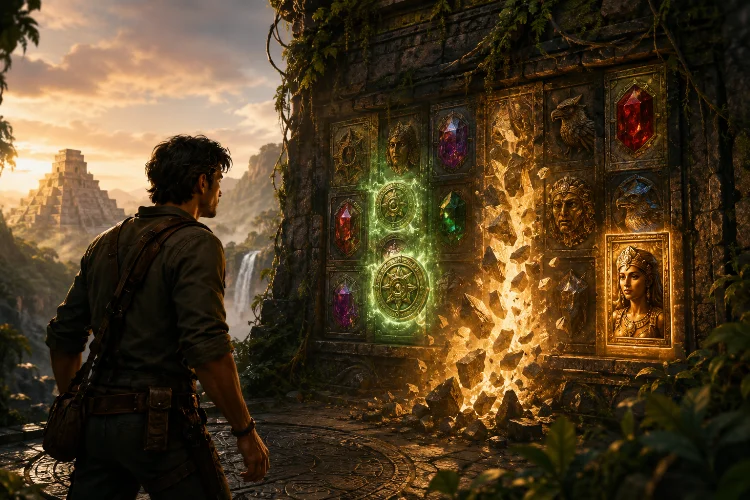
A traditional slot can communicate almost everything through symbols and numbers. Three matching icons create a win, scatters start a bonus, and wilds substitute for other symbols. Efficient? Yes. Memorable? Not always.
Narrative-driven games take a different approach.
By combining Slot Features with Narrative Design, developers can make the same underlying mechanic feel like part of an unfolding event. A cascade becomes destruction inside a fantasy world. A sticky wild represents an ally joining the battle. A multiplier meter becomes a hero charging an attack.
The underlying probabilities are still mathematical, but the way players read those probabilities and features changes.
Research into storytelling in digital games has found that narrative elements can improve perceived engagement and interest, although overly elaborate storytelling can also compete with task-focused attention.
That trade-off is especially relevant to slots, where mechanics need to remain understandable within seconds.
Narrative Can Turn Abstract Rules Into Mental Models
Slot mechanics are often described using technical language.
Cascades.
Persistent wilds.
Dynamic reels.
Progressive multipliers.
To someone already familiar with modern games, these terms are straightforward. To a first-time user, they can sound like a manual.
Narrative can translate them into more intuitive mental models.
Imagine a warrior character whose sword becomes stronger after every cascade.
The mathematical rule might be:
Multiplier increases by one level after each qualifying reaction.
The narrative version becomes:
Each successful attack strengthens the warrior.
Both describe the same feature.
The second simply provides a memorable metaphor.
This can reduce the cognitive effort required to understand what is changing during the feature.
It is similar to good icon design: instead of memorising an abstract rule, the user recognises a familiar idea.
Story Pacing Can Mirror Feature Pacing
Narratives usually have rhythms.
Introduction.
Build-up.
Conflict.
Climax.
Resolution.
Bonus features often follow a surprisingly similar pattern.
A base game establishes the normal state. Scatters create anticipation. A trigger moves the player into a different mode. Multipliers or persistent symbols build throughout the feature. The round then ends with a final total.
Narrative Design can align those stages.
Play’n GO’s 13th Trial Hercules Abyssways uses an evolving Free Spins grid where mythology and mechanical changes occur together. Hera removes symbols, Zeus influences wilds, and Pegasus interacts with Hercules symbols as the board changes.
This means feature escalation can also feel like narrative escalation.
The board is not simply becoming mechanically different.
The story is becoming more intense at the same time.
That alignment creates pacing without requiring cutscenes or lengthy dialogue.
Progression Changes How Features Are Perceived
A feature that happens instantly feels different from one that develops over time.
Suppose a multiplier jumps directly from 1x to 10x.
Now compare that with a feature where it grows from 1x to 2x, 3x, 5x, and eventually 10x while visual elements evolve around it.
The final mathematical value might be similar, but the second system communicates progression.
Play’n GO has explicitly discussed designing mechanics that build a sense of momentum and progression. Its Blitzways mechanic, for example, combines cascading wins, dynamic reels, and Sticky Wild multipliers that can increase through subsequent wins.
Narrative can reinforce this progression.
A temple opens room by room.
A character gains equipment.
A spaceship moves between planets.
An enemy becomes increasingly damaged.
These story states give mechanical progression an understandable direction.
Instead of “the number went up,” the interation becomes “the journey moved forward.”
Character Roles Can Organise Complex Features
Games sometimes have too many effects competing for attention.
One symbol expands.
Another collects values.
A third creates wilds.
A fourth activates a respin.
This can quickly become messy.
Characters can act as organisers.
Play’n GO’s Trinity Impact uses a group of heroes and connects its magical setting with transforming wilds, respins, and an Ultimate Attack feature.
The broader design lesson is useful beyond that specific game.
If every character consistently represents a particular mechanical behaviour, the cast becomes part of the interface vocabulary.
A fire character might always multiply values.
A healer might restore symbols.
A thief might collect prizes.
Those relationships do not change the probability model, but they change how quickly someone can understand what is happening.
Consistency is what makes the system work.
Randomly changing character functions from one feature to another would destroy the mental shortcut.
The Environment Can Become a Progress Indicator
Traditional interfaces use progress bars.
Narrative-driven games can let the environment perform some of that job.
Imagine a journey through five locations.
Each bonus stage moves into a new area, and every area introduces another modifier.
The player understands progression because the scenery changes.
Play’n GO’s Rosy Orbit Treasure Turn connects spatial movement directly to its mechanics. The grid rotates after wins, symbols shift, and larger symbols interact with the board while the whole experience is framed around a tiny cosmic world.
This is a strong example of mechanics and setting sharing the same visual language.
The feature literally moves through space.
As a result, animation is doing several jobs simultaneously:
showing the outcome,
explaining the mechanic,
and reinforcing the story.
That is much more efficient than simply adding decorative effects around an unrelated game system.
Story Can Make Feature Transitions Easier to Notice
One of the biggest UX problems in feature-heavy slots is state change.
When exactly did the normal game end?
Did Free Spins begin?
Is that multiplier still active?
Will the wild remain for the next cascade?
Narrative transitions can help answer these questions.
The screen might move into another location when Free Spins begin.
Music can change.
A character can enter the scene.
Lighting can shift.
These cues tell the player that the rules have changed.
Good audiovisual communication is especially helpful when the rules of the feature differ substantially from the base game.
However, storytelling should remain supportive rather than overwhelming.
The Frontiers storytelling study found greater engagement and interest with narrative content but also slightly reduced task-focused performance in its particular rhythm-game experiment.
That research was not about slots, but the broader lesson is relevant: more story is not automatically better.
If the spectacle hides the important mechanical information, Narrative Design has failed its UX job.
Narrative Should Not Imply Fake Control
There is another important boundary.
Stories naturally create ideas of agency.
A hero chooses a path.
A character attacks an enemy.
A player opens a treasure chest.
In a random slot, however, narrative presentation should not create a misleading impression that fictional choices alter probability when they do not.
If three treasure chests all reveal predetermined random outcomes with identical mathematical probabilities, the interface should not imply that one can be strategically identified as the “best” chest.
Similarly, a character getting visibly closer to a bonus should only communicate real progression when the game actually tracks such progress.
Great Britain’s Gambling Commission requires game descriptions to explain how the game works, how winners are determined, and relevant information about RTP, house edge, or winning probabilities.
Clear rules therefore remain the foundation.
Story can make mechanics friendlier.
It should never make random events look skill-based when they are not.
Feature Design Can Also Carry the Story
Narrative is strongest when it does not need to stop gameplay to explain itself.
Instead of adding a long introduction, developers can let the mechanics tell the story.
Play’n GO described 13th Trial Hercules Abyssways as a design where mythology and mechanics merge, with characters affecting the grid through the same actions that drive the feature.
That is an important distinction.
A slot with an Egyptian background and completely unrelated cyberpunk bonus mechanics has a theme.
A slot where exploration, characters, symbols, bonuses, and progression all behave according to the same fictional idea has deeper narrative integration.
The second approach creates coherence.
Players do not need to seperate the story from the game system because the system itself communicates the story.
That can make even relatively simple mechanics feel distinctive without making the mathematical model unnecessarily complicated.
Good Narrative Design Makes Mechanics Easier, Not Harder
The best test is surprisingly simple.
Remove the narrative presentation and look at the mechanic.
Can it still be explained clearly?
Now restore the narrative.
Does the story make the mechanic easier to recognise, remember, or anticipate?
If yes, the integration is probably working.
If the player now needs three extra paragraphs of lore just to understand what a wild does, the design may have gone too far.
Slots operate in a fast visual enviroment, so narrative communication needs to be compact.
Characters, colour changes, progression states, environmental movement, and sound cues often work better than lengthy exposition.
The goal is not to turn every slot into an interactive novel.
It is to give each mechanical event context.
That context is what transforms a collection of features into a coherent game world.
Slot Features and Narrative Design work best when story helps players read the mechanics rather than distracting from them. Characters can explain abilities, environments can show progression, and bonus transitions can become meaningful story events.
Developers should keep probability information clear while using narrative to organise complex features. When mechanics tell the story themselves, the entire game feels more connected.